The Honeypot: Why We Click "Deposit"
You're scrolling through DeFi protocols late at night. The market has been sideways for weeks. Your ETH is just sitting there, doing nothing. Then you see it: 28% APY on a "covered call strategy" vault. No lockup period. Automated. "Institutional-grade risk management."
You click deposit.
Three months later, Bitcoin pumps 40%. Your friends who simply held are celebrating. But you? You're staring at a screen showing you lost money in a bull market. How is that possible?
Welcome to the hidden world of DeFi Option Vaults (DOVs)—where high yields often come with capped upsides and unlimited regret.
The Allure: Yield in a Barren Market
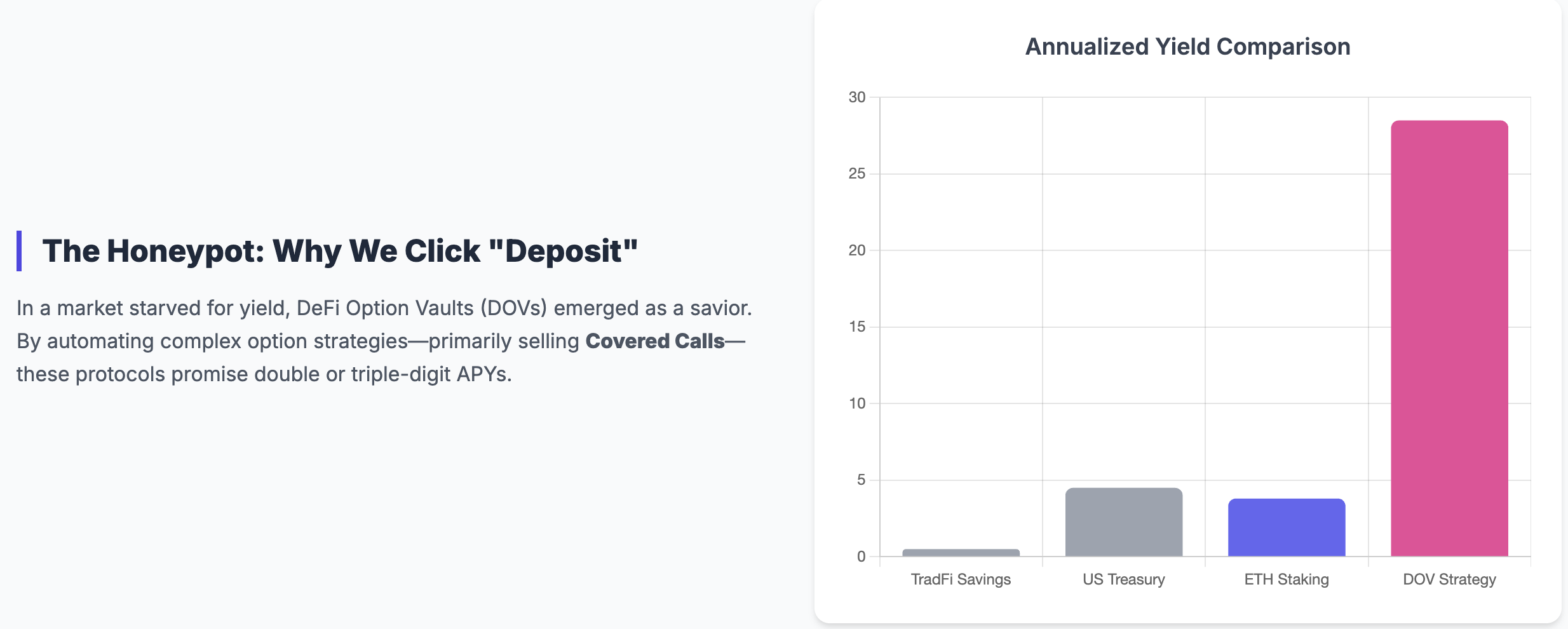
In traditional finance, you're lucky to get 4-5% on a Treasury bond. Savings accounts offer a laughable 0.5%. Even ETH staking caps out around 3-4% APY. But DeFi Option Vaults? They promise double or triple-digit returns.
The pitch is simple: "We automate complex option strategies so you don't have to think about it. Just deposit your crypto and earn passive income."
For the average crypto trader—someone who understands the basics but isn't running a hedge fund—this sounds perfect. You get exposure to sophisticated strategies without needing a PhD in quantitative finance.
But here's what they don't tell you upfront: You're not earning "free money." You're selling something extremely valuable—your upside potential.
How DOVs Actually Work
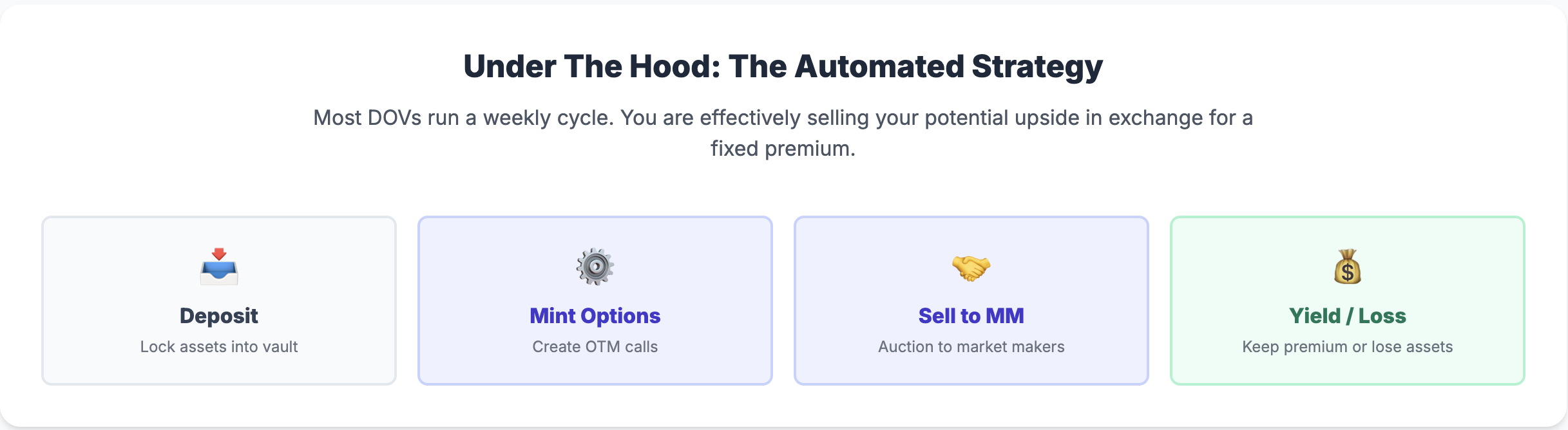
Most DeFi Option Vaults run a strategy called Covered Call Selling. Here's the lifecycle:
Step 1: You Deposit
You lock your ETH or BTC into the vault before Friday's options expiry. Your assets become collateral.
Step 2: The Vault Mints Options
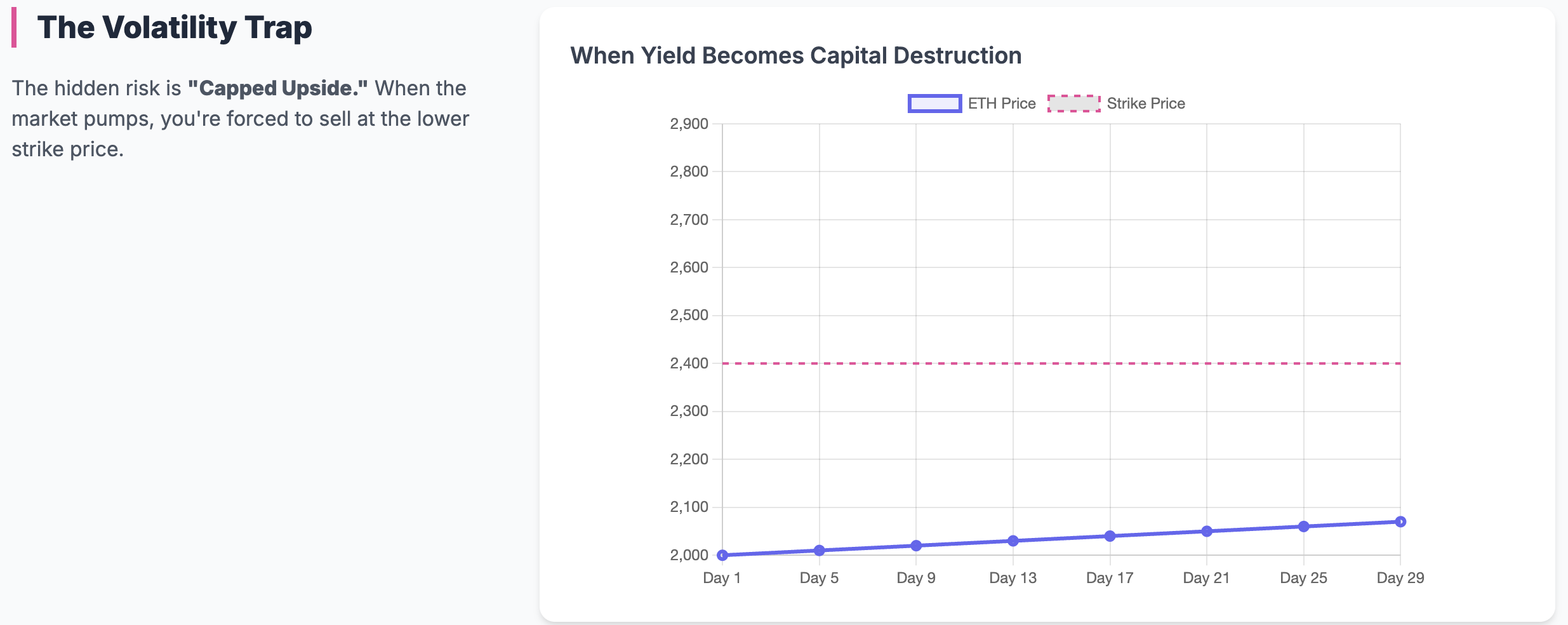
The protocol automatically creates "Call Options" that are Out-of-The-Money (OTM)—meaning the strike price is above the current market price. For example, if ETH is at $2,000, the vault might sell calls with a $2,400 strike.
Step 3: Options Are Sold
These options are auctioned off to Market Makers (professional traders). The vault collects a premium—this is where your "yield" comes from.
Step 4: Settlement
On Friday, one of two things happens:
- Price stays below strike: You keep your ETH + the premium. Win!
- Price goes above strike: Your ETH gets sold at the strike price. You miss the rally. Loss.
The Trap: When "Yield" Becomes Capital Destruction
Here's where it gets painful. Let's say you deposited 10 ETH when the price was $2,000. The vault sold $2,400 calls and collected a 2% premium ($400).
Scenario 1: ETH stays at $2,000
You keep your 10 ETH + $400 premium. Annualized, this is great yield. The strategy works.
Scenario 2: ETH pumps to $2,800
Your ETH gets called away at $2,400. You receive $24,000 + $400 premium = $24,400 total.
But if you had just held, your 10 ETH would be worth $28,000. You lost $3,600 by chasing yield.
This is called "Capped Upside"—and it's the silent killer of DOV returns in bull markets.
The Negative Selection Problem
Why do professional Market Makers eagerly buy these options from retail-focused vaults? Because they know something you don't: the options are often mispriced.
When volatility is high (which is when DOV yields look most attractive), it's also when the probability of a big move is highest. You're selling lottery tickets right before the drawing.
Market Makers have sophisticated models. They know when implied volatility is underpriced. They buy your options, hedge them dynamically, and profit when the market moves violently—which it often does in crypto.
You, on the other hand, are stuck with a fixed premium and unlimited regret.
Breaking Down the Risk Factors
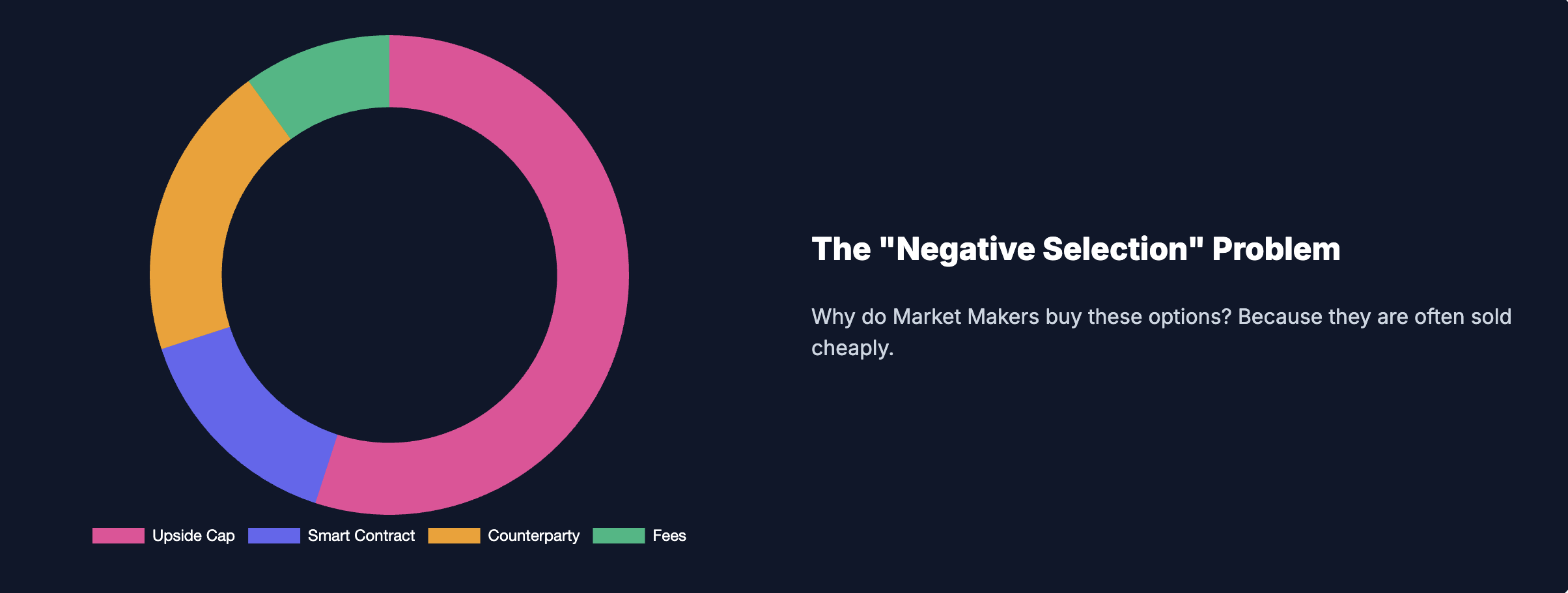
1. Impermanent Loss (55% of risk)
This isn't traditional impermanent loss from AMMs. It's opportunity cost. Every time the market rallies past your strike, you're losing potential gains. In a strong bull market, this compounds week after week.
2. Counterparty Risk (20%)
What if the exchange or clearing mechanism fails? What if the Market Maker defaults? Your collateral could be at risk. This isn't theoretical—we've seen DeFi protocols collapse before.
3. Smart Contract Risk (15%)
Bugs, exploits, admin key compromises. If the vault's smart contract has a vulnerability, your funds could be drained. Even audited protocols have been hacked.
4. Fee Drag (10%)
Most vaults charge 2% management fees + 20% performance fees. These eat into your returns, especially when yields are already being eroded by capped upside.
When DOVs Actually Make Sense
DOVs aren't scams. They're tools. But like any tool, they work best in specific conditions:
✅ Sideways Markets
When you genuinely believe the market will trade in a range for weeks or months, selling covered calls makes sense. You're monetizing low volatility.
✅ Bear Markets
If you're bearish but don't want to sell, earning premium while waiting for lower prices can cushion the downside.
✅ Tax Loss Harvesting
In some jurisdictions, getting called away at a strike can create a taxable event that offsets other gains. Consult a tax professional.
❌ Bull Markets
If you think we're entering a sustained rally, DOVs will almost always underperform simple holding. The premium you earn won't compensate for the upside you miss.
The BlockSkew Checklist: Before You Deposit
1. Check Market Sentiment
Is the market trending violently upward? Are we breaking multi-month resistances? If yes, do not deposit. You're selling upside right before a potential moonshot.
2. Inspect Strike Distance
How far Out-of-The-Money are the strikes? If they're only 5-10% above current price, you're at high risk of getting called away. Look for vaults selling strikes at least 15-20% OTM.
3. Understand Denomination
Are you earning yield in USDC or in the native token (ETH/BTC)? If you're earning in the native token and it's depreciating, you're getting paid in a currency that's losing value. Double whammy.
4. Read the Fine Print on Fees
2% management + 20% performance fees are standard, but some vaults charge more. If the vault is taking 30-40% of your gains, you need exceptionally high gross returns just to break even.
5. Check Historical Performance
Don't just look at APY. Look at actual returns vs. holding. Many vaults advertise "30% APY" but if you zoom out, holders would have made more by doing nothing.
6. Assess Smart Contract Risk
Is the vault audited? By whom? How long has it been live? Has it been forked from a battle-tested protocol or is it a new experiment? New = higher risk.
The Brutal Truth
DeFi Option Vaults are not "passive income." They're active bets on low volatility. When you deposit, you're making a directional call: "I believe the market will stay range-bound."
If you're wrong—if the market rips higher—you will underperform. Badly.
The 28% APY you saw advertised? That's an annualized projection based on current premiums. It assumes you can repeat the same strategy every week for a year without getting called away. In practice, this almost never happens in crypto.
The bottom line: DOVs are not a replacement for holding. They're a tool for experienced traders who have a specific view on volatility and are willing to sacrifice upside for income.
If you're a passionate crypto trader who believes in the long-term potential of your assets, the best strategy is often the simplest: just hold. No fancy vaults. No algorithmic strategies. Just patience.
Because in crypto, the biggest gains don't come from chasing yield. They come from being positioned when the market decides to move—and not having sold your upside for a 2% premium.