The "Free Money" Trade That Broke the Market
In July 2024, Bitcoin crashed 18% in a matter of days. Ethereum dropped 22%. The entire crypto market bled billions.
But here's the thing: there was no crypto-specific news.
No exchange hack. No regulatory crackdown. No major protocol failure.
So what happened?
The answer lies in a corner of traditional finance that most crypto traders don't pay attention to: the Japanese Yen carry trade.
What Is the Carry Trade?
The carry trade is one of the oldest strategies in finance. Here's how it works:
Step 1: Borrow Cheap Money
You borrow Japanese Yen (JPY) at near-zero interest rates. For years, Japan's central bank (the Bank of Japan, or BOJ) kept rates at 0% to 0.1%.
Step 2: Convert to Dollars
You take that borrowed Yen and convert it to US Dollars (USD).
Step 3: Buy High-Yield Assets
You use those dollars to buy assets that pay higher returns—stocks, bonds, real estate, or in recent years, Bitcoin.
As long as the interest rate on your Yen loan stays low and your investments go up, you make money. It's "free" leverage.
But there's a catch.
The Unwind: When Free Money Becomes Expensive
What happens when the Bank of Japan raises interest rates?
Suddenly, that "cheap" Yen loan isn't cheap anymore. You're paying more interest. And if the Yen strengthens against the Dollar (which it does when rates rise), you need more dollars to pay back the same amount of Yen.
This creates a panic.
Traders who borrowed Yen to buy Bitcoin now need to sell Bitcoin to get dollars, convert those dollars to Yen, and pay back their loans before they lose even more money.
This is the carry trade unwind. And it's brutal.
July 2024: The Great Unwind
In July 2024, the Bank of Japan surprised markets with a rate hike. It was small—just 0.15%—but it was enough to trigger a cascade.
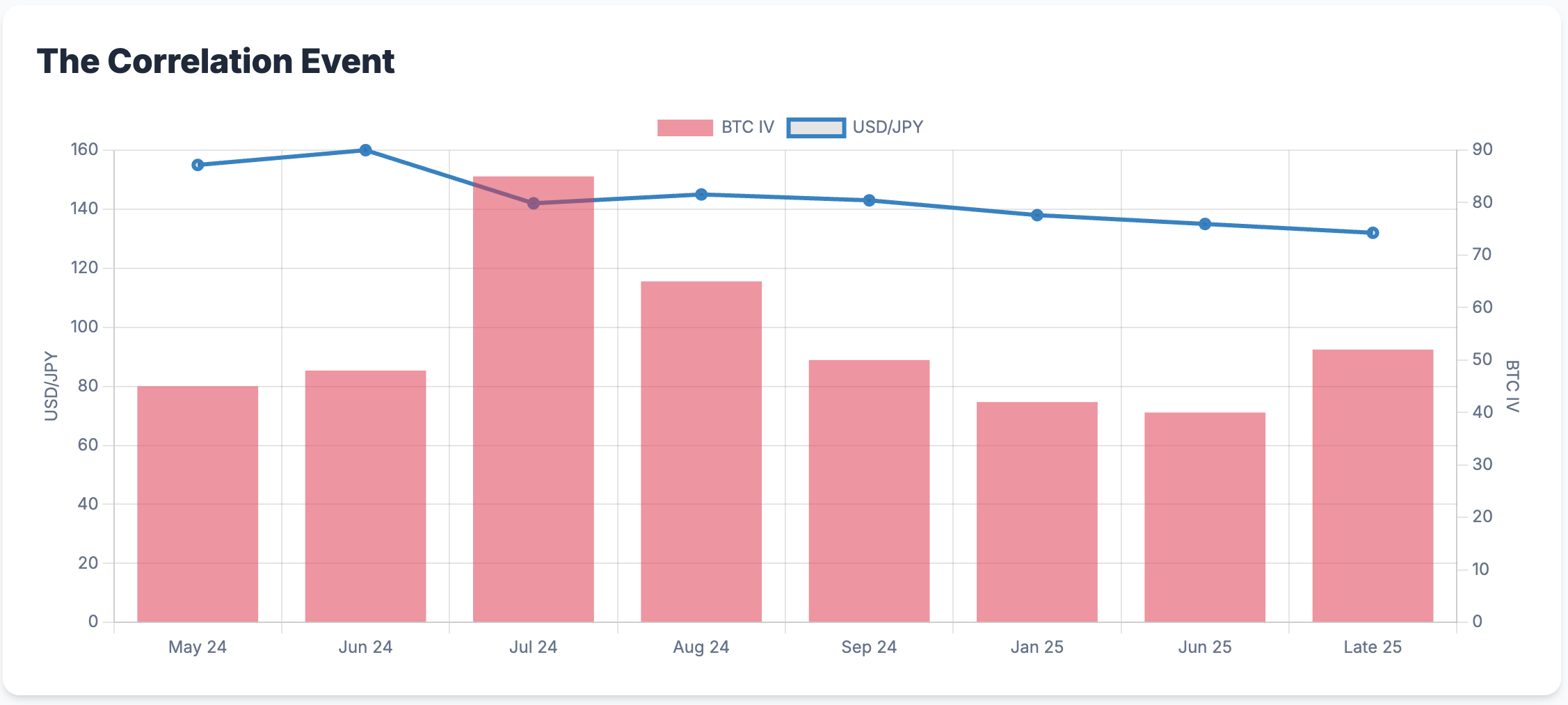
Look at that chart. See the spike in July 2024?
The USD/JPY exchange rate (blue line) collapsed from 160 to 142. That's a massive move in currency markets.
At the same time, Bitcoin's implied volatility (red bars) exploded to 85—the highest level since the 2022 bear market.
This wasn't a coincidence. It was a forced liquidation event.
Why Crypto Got Hit So Hard
You might be wondering: "Why did Bitcoin crash if this was a Yen problem?"
Because Bitcoin had become a carry trade asset.
Hedge funds, family offices, and even retail traders were borrowing Yen to buy Bitcoin. When the carry trade unwound, they had to sell Bitcoin to cover their Yen loans.
But it wasn't just the carry trade. The July 2024 crash was a perfect storm of multiple factors:
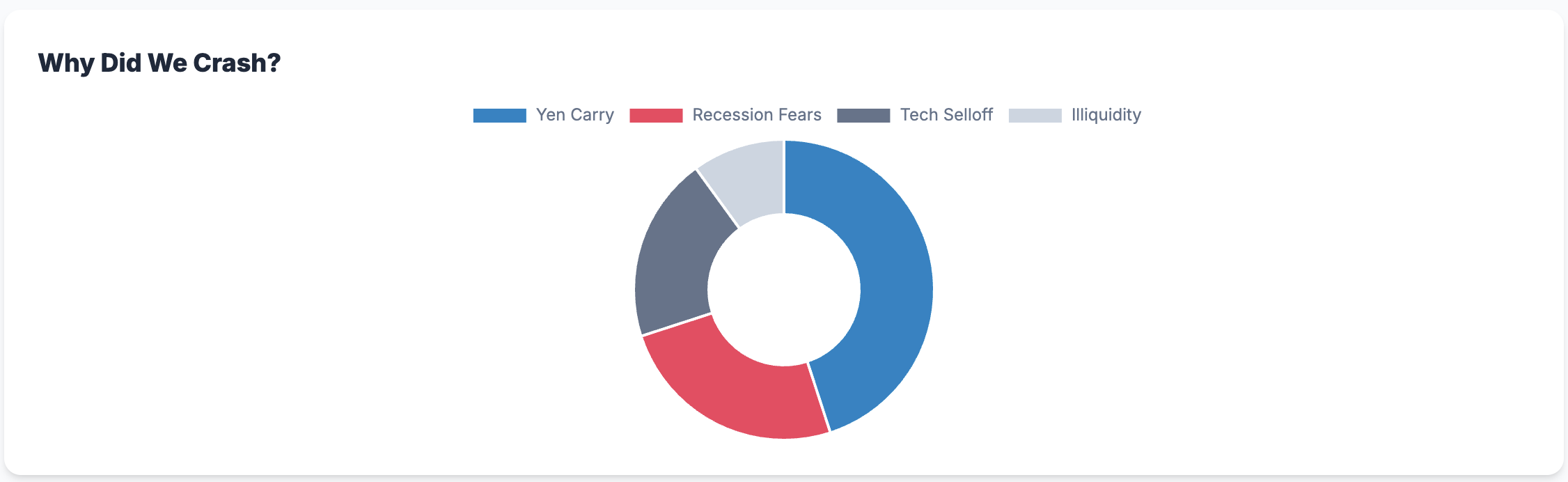
Let's break down the attribution:
45% - Yen Carry Unwind
The primary driver. Forced selling from traders unwinding leveraged positions.
25% - US Recession Fears
Weak economic data in the US spooked markets. When recession fears rise, risk assets (like Bitcoin) get sold first.
20% - Tech/AI Selloff
The AI bubble was deflating. Nvidia and other tech stocks crashed, pulling crypto down with them.
10% - Summer Illiquidity
Low trading volume in August amplified the moves. Thin order books mean bigger price swings.
The Recent Hike: Why It Was Different
Fast forward to late 2025. The Bank of Japan raised rates again.
But this time? Bitcoin barely flinched.
Implied volatility ticked up to 52—elevated, but nowhere near the 85 we saw in July 2024.
What changed?
1. The Market Learned
After the July 2024 shock, traders de-risked. They closed out leveraged Yen positions. The carry trade was no longer as crowded.
2. The Hike Was Expected
Unlike July 2024, the late 2025 hike was telegraphed. Markets had time to prepare. No one was caught off guard.
3. The Rate Gap Is Closing
The spread between US and Japanese interest rates is narrowing. This makes the carry trade less attractive.
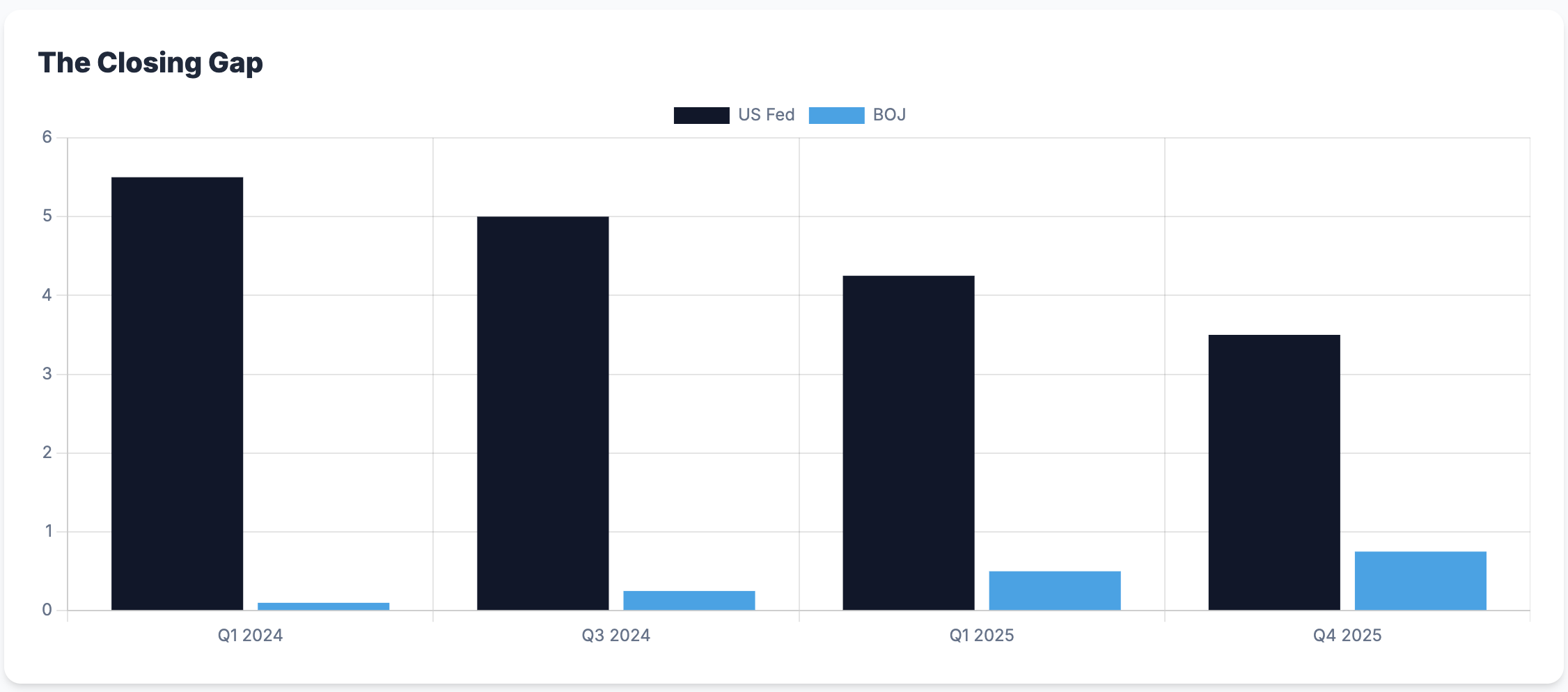
Look at the bars. In Q1 2024, the US Fed rate was 5.5% while the BOJ rate was 0.1%. That's a 5.4% spread—massive incentive to borrow Yen and buy dollar assets.
By Q4 2025, the Fed rate is projected at 3.5% while the BOJ rate is 0.75%. That's only a 2.75% spread.
The carry trade is becoming less profitable. And as it becomes less profitable, fewer people do it. And when fewer people do it, there's less risk of a violent unwind.
What This Means for Crypto Traders
If you're trading Bitcoin and you're not watching the USD/JPY pair, you're flying blind.
Here's why:
1. USD/JPY Is a Liquidity Indicator
When USD/JPY is stable or rising, it means the carry trade is working. Liquidity is flowing into risk assets like Bitcoin.
When USD/JPY crashes (like in July 2024), it means liquidity is being pulled out. Bitcoin will follow.
2. Watch the 140 Level
The 140.00 level on USD/JPY is critical. If it breaks rapidly, expect short-term volatility spikes in crypto.
3. Implied Volatility Is Your Early Warning
When Bitcoin's implied volatility starts rising without any crypto-specific news, check the Yen. It's often a macro unwind.
The Bigger Picture: Crypto Is No Longer Isolated
The July 2024 crash taught us something important:
Crypto is no longer isolated from traditional finance.
Bitcoin is now a global macro asset. It's correlated with stocks, bonds, currencies, and interest rates.
This is both good and bad.
The Good: Institutional adoption. Bitcoin is being treated as a legitimate asset class.
The Bad: Crypto now crashes when TradFi crashes. You can't ignore macro anymore.
How to Trade This
If you want to use this information, here's a simple framework:
Step 1: Monitor USD/JPY
Use a site like TradingView or Bloomberg to track the USD/JPY exchange rate. If it's dropping rapidly (Yen strengthening), be cautious with long Bitcoin positions.
Step 2: Watch BOJ Announcements
The Bank of Japan typically announces rate decisions 8 times per year. Mark these dates on your calendar. Volatility often spikes around these events.
Step 3: Check Implied Volatility
If Bitcoin's IV is rising without crypto-specific news, it's likely a macro event. This is your signal to either hedge or reduce leverage.
Step 4: Use Options for Protection
If you're long Bitcoin and you see USD/JPY breaking down, consider buying short-term Put options as insurance. They're cheap when volatility is low, and they can save you during a carry trade unwind.
The Carry Trade Isn't Dead
Despite the July 2024 crash and the recent rate hikes, the carry trade isn't going away.
Why? Because as long as there's a rate differential between countries, traders will exploit it.
But the nature of the carry trade is changing.
It's becoming less extreme. The spreads are narrowing. The leverage is lower. The positions are smaller.
And that's actually good for Bitcoin.
Because it means the next unwind—and there will be a next unwind—won't be as violent as July 2024.
The Lesson: Macro Matters
If you're a crypto trader, you can't ignore traditional finance anymore.
You need to understand:
- Interest rate differentials and how they drive carry trades
- Currency markets and how they affect liquidity
- Central bank policy and how it ripples through risk assets
Because the next time Bitcoin crashes 18% in a week, it might not be because of crypto news.
It might be because of a rate hike in Tokyo.
Why Blockskew Tracks This
At Blockskew, we don't just show you Bitcoin's price and volatility.
We show you the macro context.
We track:
- USD/JPY movements and their correlation with Bitcoin
- Interest rate spreads between major economies
- Implied volatility across different expirations
- Carry trade positioning through options flow data
Because understanding why Bitcoin moves is just as important as knowing that it moved.
The Bottom Line
The carry trade unwind is a reminder that crypto doesn't exist in a vacuum.
Bitcoin is now a global macro asset. It's affected by interest rates, currency markets, and central bank policy.
The July 2024 crash was a wake-up call. The recent hike showed that markets can adapt.
But the risk isn't gone. It's just evolved.
Watch the Yen. Watch the rates. Watch the macro.
Because the next crash might not come from crypto. It might come from Tokyo.