The 24-Hour Lottery Ticket
Imagine buying an option that expires in less than 24 hours. Not next week. Not next month. Today.
This is the world of 0DTE (Zero Days to Expiry) options—the fastest-growing segment in options trading. In traditional markets like the S&P 500, they now account for nearly half of all daily options volume. And crypto markets are rapidly following suit.
But here's the question that keeps regulators up at night: Are these sophisticated hedging instruments, or are they just lottery tickets dressed up in financial jargon?
The Theta Cliff: When Time Is Your Enemy
To understand 0DTE options, you need to understand Theta—the rate at which an option loses value as time passes.
For a standard 30-day option, time decay is gradual. You lose a little value each day, but you have time to be right. The market can move in your favor over weeks.
For a 0DTE option? Time decay is a cliff.
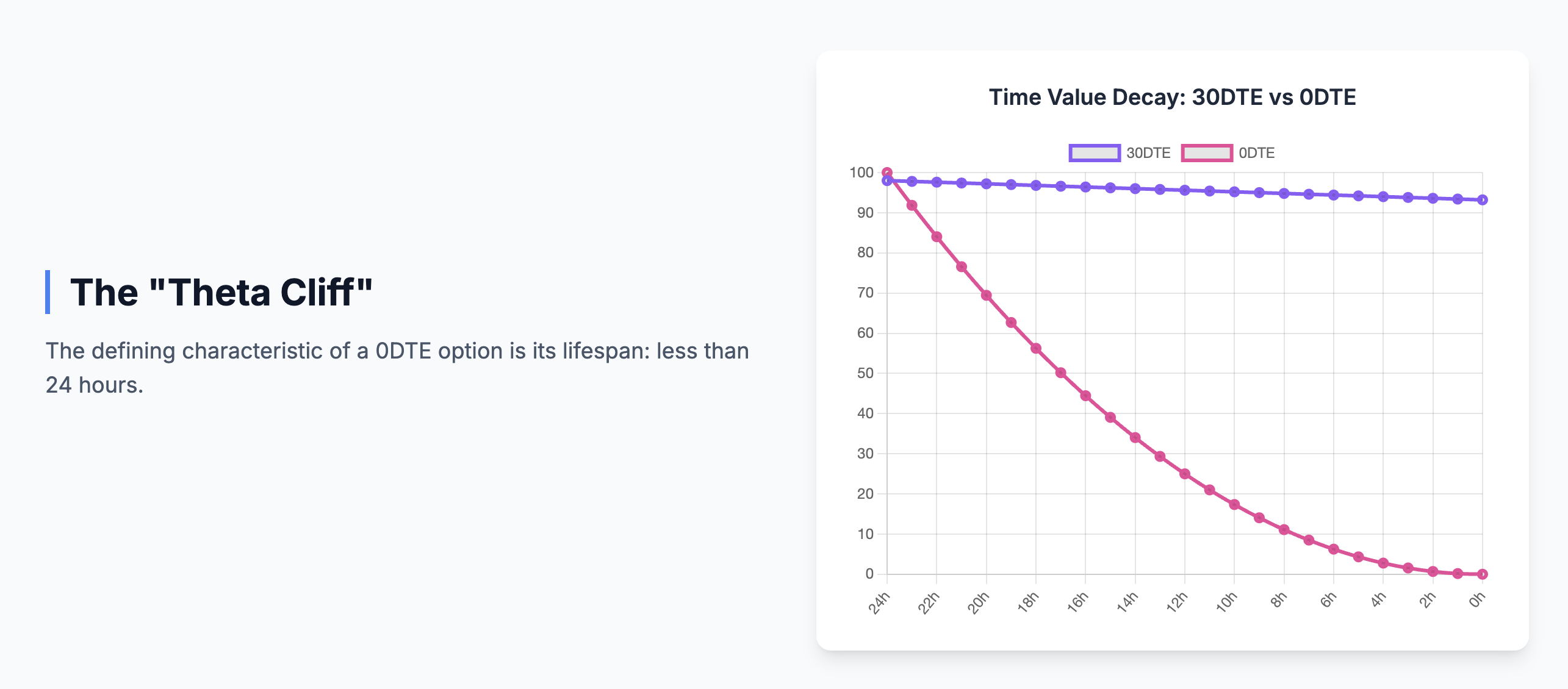
Look at that pink line. In the final 6 hours before expiry, a 0DTE option can lose 80% of its remaining value—even if the underlying price doesn't move.
This creates a brutal dynamic: You need to be right, and you need to be right immediately. There's no room for "wait and see." Every hour that passes without the market moving in your favor is money evaporating from your position.
The Explosion of Short-Duration Trading
So why would anyone trade these ticking time bombs?
Because when they work, they work spectacularly.
A 0DTE call option that's 2% out-of-the-money might cost $50. If the market pumps 3% in the next hour, that same option could be worth $500. That's a 10x return in 60 minutes.
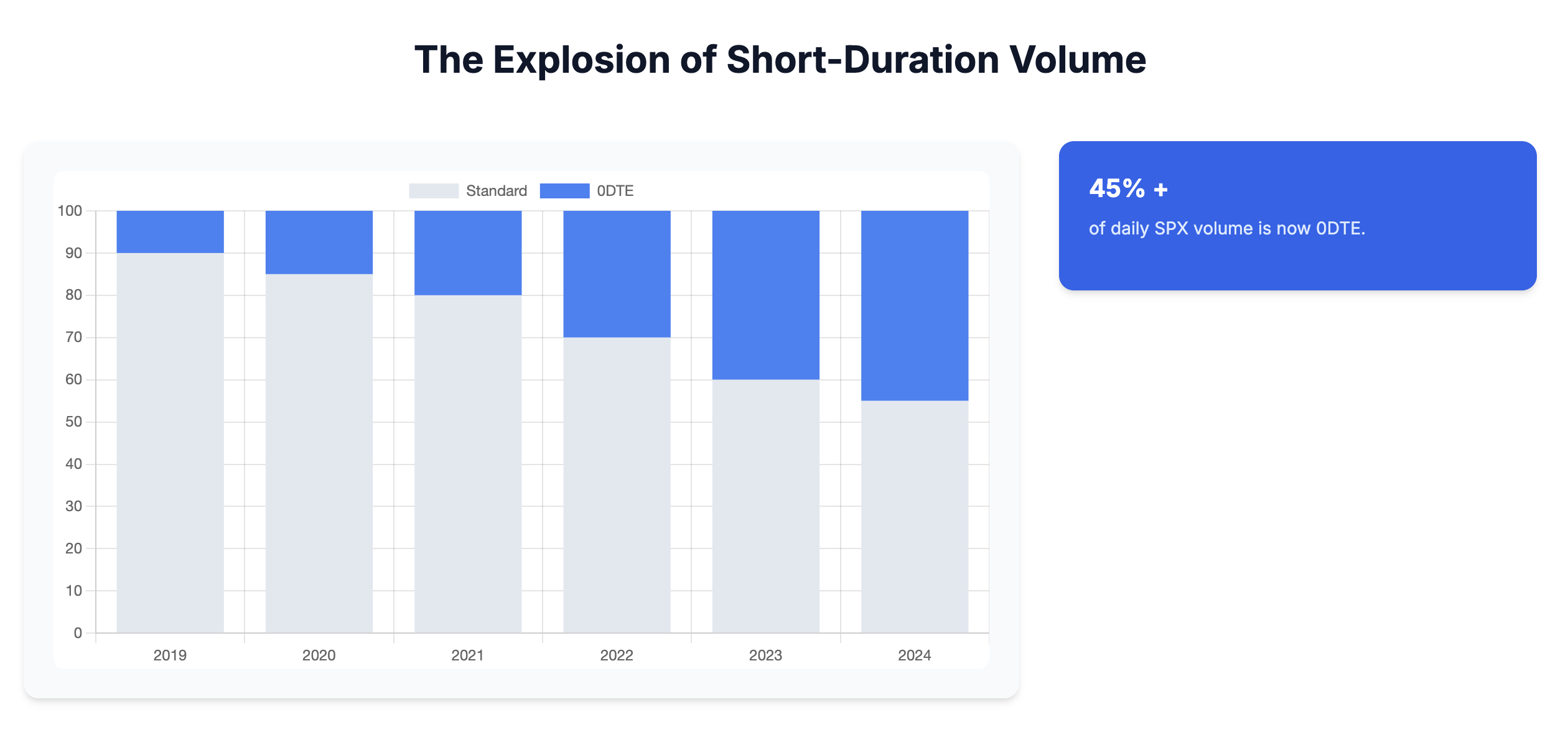
This potential for explosive gains has created a feeding frenzy. In traditional markets, 0DTE volume has grown from virtually nothing in 2019 to representing 45% of all options volume in 2024.
Crypto markets are following the same trajectory. Major exchanges now offer daily expirations for Bitcoin and Ethereum. Some even offer hourly expirations.
The appeal is simple:
- Lower upfront cost: Because they expire so quickly, 0DTE options are cheap. This allows for massive leverage with small capital.
- Event-driven hedging: Perfect for protecting against specific events like Fed announcements or CPI data releases.
- Instant feedback: You know if you're right or wrong within hours, not weeks.
The Gamma Trap: When Small Moves Create Massive Swings
Here's where things get dangerous.
Gamma measures how quickly an option's Delta (price sensitivity) changes. For 0DTE options, Gamma is explosive.
What does this mean in practice? A 1% move in Bitcoin's price can turn a worthless 0DTE option into a 10x winner—or wipe out your entire position in minutes.
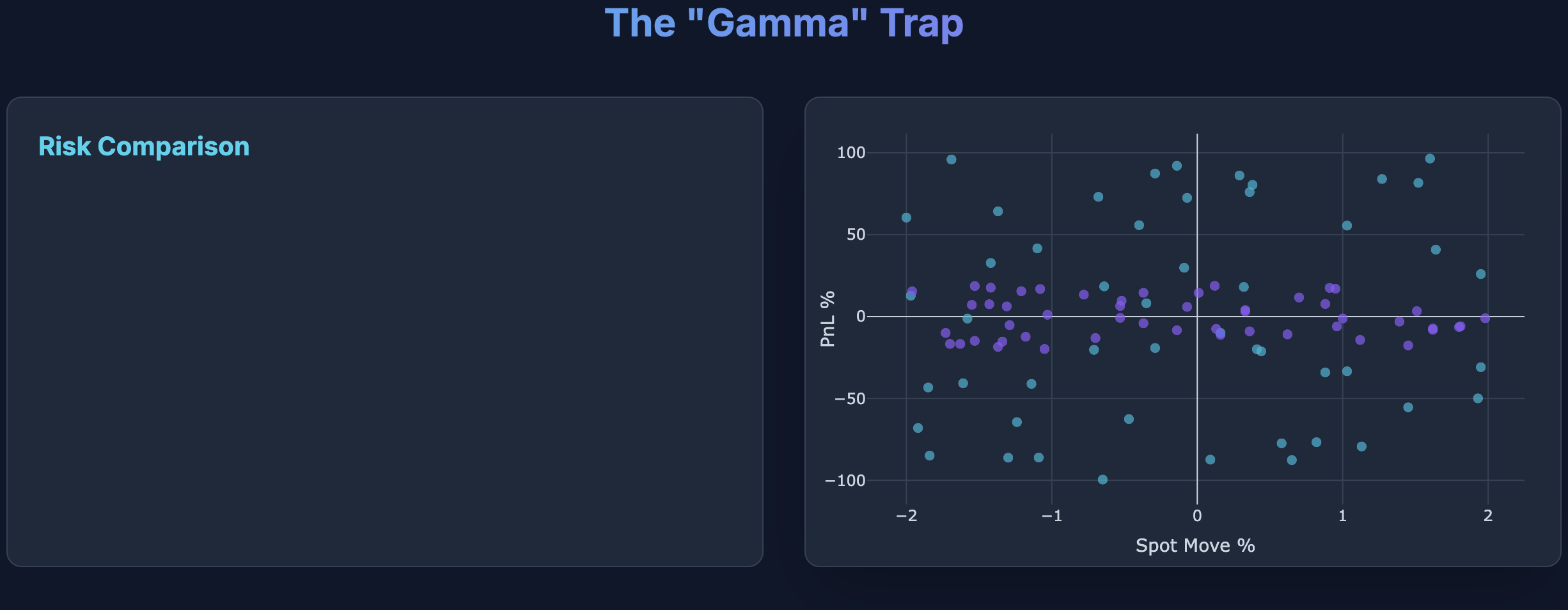
Look at the scatter plot. The cyan dots represent 0DTE options. Notice how spread out they are? A tiny 1% move in the underlying asset can create PnL swings of +200% or -100%.
Compare that to the purple dots (30-day options). They're clustered tightly. The same 1% move might only create a 20% PnL swing.
This is the Gamma Trap. 0DTE options amplify every market move to an extreme degree. You're not just betting on direction—you're betting on immediate, violent movement.
Who's Trading These Things?
The answer might surprise you.
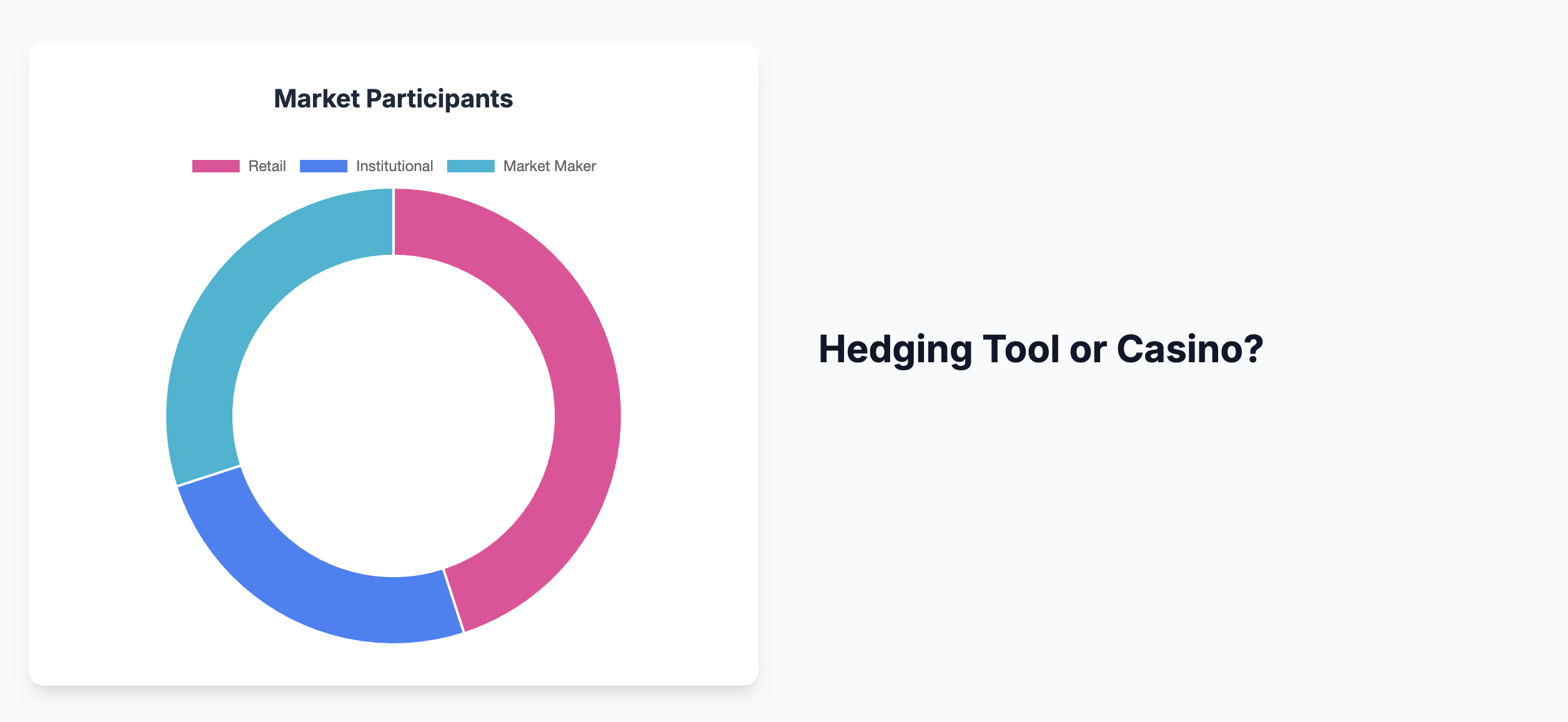
45% Retail Speculation (Pink)
This is the "lottery ticket" crowd. They're buying cheap out-of-the-money calls hoping for a moonshot. Statistically, most of these trades expire worthless. But the winners are so spectacular that people keep coming back.
25% Institutional Hedging (Blue)
This is the "sophisticated" use case. A fund manager has a $100M portfolio and wants to protect against a specific event (like a Fed rate decision) happening at 2pm. They buy 0DTE puts as cheap insurance. If nothing happens, the puts expire worthless—but that's fine, because the cost was minimal.
30% Market Maker Activity (Cyan)
Market makers sell these options to both retail and institutions, then hedge their exposure dynamically. They profit from the bid-ask spread and from Theta decay.
Hedging Tool or Casino?
The answer is: both.
It depends entirely on how you use them.
The Hedger's Approach:
You have a $50,000 Bitcoin position. The Fed is announcing interest rates in 3 hours. You're worried about a hawkish surprise that could tank the market.
You buy $200 worth of 0DTE puts, 5% out-of-the-money. If Bitcoin crashes, your puts explode in value and offset your portfolio losses. If nothing happens, you lose $200—a small price for peace of mind.
This is precision risk management. You're using 0DTE options as a scalpel.
The Gambler's Approach:
You have $500 in your account. You buy 0DTE calls that are 10% out-of-the-money, hoping Bitcoin pumps before close. You have no underlying position to hedge. You're just betting on a big move.
This is speculation. You're using 0DTE options as a slot machine.
The Brutal Math
Here's the thing that most retail traders don't understand: 0DTE options are a negative-sum game for speculators.
Why? Because of Theta decay.
Let's say you buy a 0DTE call with 6 hours left to expiry. Even if the market doesn't move against you, you're losing value every minute. To break even, the market needs to move more than the Theta decay.
And remember: market makers are on the other side of your trade. They're professionals with sophisticated hedging systems. They're selling you options that are statistically overpriced relative to the actual probability of the market moving enough to make you profitable.
In other words: the house has an edge.
When 0DTE Makes Sense
Despite the risks, there are legitimate use cases:
1. Event Hedging
You know a specific catalyst is happening at a specific time (earnings, Fed decision, CPI data). You want cheap, temporary protection. 0DTE options are perfect for this.
2. Intraday Scalping (For Pros)
If you're a professional trader with real-time data and fast execution, you can exploit short-term mispricings in 0DTE options. But this requires skill, technology, and discipline.
3. Portfolio Rebalancing
Institutions use 0DTE options to make quick tactical adjustments to large portfolios without moving the underlying market.
❌ When 0DTE Doesn't Make Sense:
- You're using them as a "get rich quick" strategy
- You don't have a specific catalyst or edge
- You're betting more than you can afford to lose
- You don't understand Theta, Gamma, and Delta
The Verdict
0DTE options are not inherently good or bad. They're a tool.
In the hands of a skilled hedger, they're a precision instrument for managing specific, time-bound risks.
In the hands of a gambler, they're a fast way to lose money.
The difference comes down to intent and understanding.
If you're using 0DTE options to hedge a specific event, with a clear risk/reward calculation, they can be incredibly effective.
If you're buying them because you "have a feeling" Bitcoin is going to pump, you're not trading—you're gambling.
The Blockskew Perspective
At Blockskew, we believe in informed decision-making.
0DTE options are here to stay. They're not going away. But to use them effectively, you need to understand:
- Theta decay and how it accelerates in the final hours
- Gamma risk and how small moves create massive PnL swings
- Implied Volatility and whether you're overpaying for premium
- Market structure and how dealers hedge their exposure
This is why we're building tools to visualize these dynamics in real-time. Because the difference between a hedger and a gambler isn't luck—it's information.
If you're going to trade 0DTE options, do it with your eyes open. Understand the math. Know the risks. Have a plan.
Because in a game where time is your enemy and Gamma is explosive, the only edge you have is knowledge.